Apr 30, 2020 | WiCCED Archive
Less than one third of Americans are capable of understanding the scientific issues we see in the news. It’s time to raise our standards of science and ensure these new learning approaches are available to all students regardless of income.
A scientifically literate person can tell the difference between an article based on quality scientific evidence and news with the intent to mislead. Scientific literacy means not only understanding the scientific content, but being able to make informed decisions that lead to positive policy changes. These traits are beneficial in the workplace and for creating a collective society that can think critically and make lifestyle choices to better the world in which we live. Our next step is to invest in our future—by instilling scientific literacy in our children.
To improve student understanding of the scientific process, a consortium of states, including Delaware, took part in developing the Next Generation Science Standards (NGSS). Top American research and science organizations designed a curriculum that emphasizes a greater ability to evaluate scientific evidence. The objective of these standards is to have students develop the traditional in-depth understanding of content, while also developing communication and problem-solving skills. Active- and inquiry-based learning techniques, ideas foundational to the NGSS, teach students howto think rather than whatto think. Despite research that these learning approaches improve student test scores, only “20 states and the District of Columbia have adopted the NGSS, representing about 36% of US students,” according to the National Science Teaching Foundation. Why aren’t more schools adopting these standards the way Delaware has? Cost.
The switch in curriculum from the Common Core to the NGSS requires large up-front funds, but there is no federal funding to aid in this transition. Many low-income schools cannot afford new curriculum products and may not be able to participate in these new learning techniques to the same degree found in better school districts.
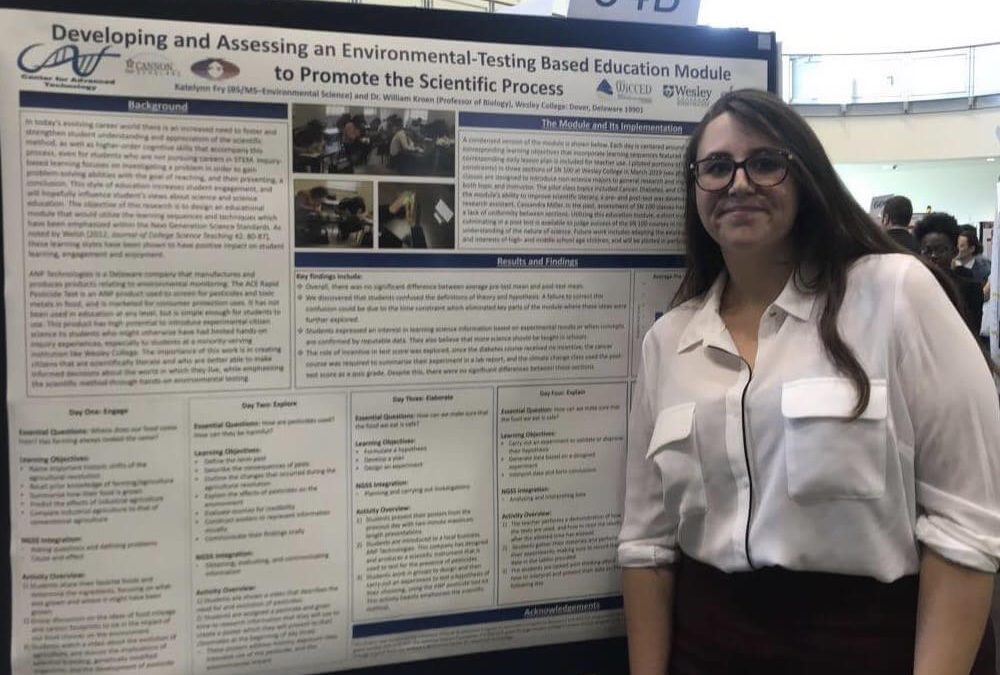
Katelynn Fry is an environmental science graduate student at Wesley College, a minority-serving liberal arts institution in Dover, Delaware. Fry is passionate about engaging the public on scientific issues relating to our changing environment. She believes that everyone should have the opportunity to understand and appreciate the scientific process and that the best way to do this is to make active- and inquiry-based learning more accessible to low-income schools.
With a partnership between Wesley College and Delaware company ANP Technologies, Fry designed an educational product from ANP that quickly detects forpesticides and toxic metals in our food and water. The low-cost test has been used widely by consumers, but not for education.
One of the ways Delaware aims to address water security issues is to address the biggest threat to water quality—human behavior. Over the last year, Fry has designed an educational module, aligned with the NGSS, that allows students to ask questions about the water in their environment. This four-day module culminates in students developing and carrying out their own experiments with water samples from across Delaware with the ANP test kit.
Fry’s research uses an affordable educational product to help increase the scientific literacy of students who otherwise wouldn’t get to participate in hands-on science. We hope that her work will help students think critically and make informed choices on decisions that impact water quality in Delaware.
It is incredibly important to teach children scientific literacy from an early age to ensure that, as adults, they are able to evaluate thevalidity of statements from the media in order todetermine what information they can rely on to make important decisions. To increase scientific literacy statewide Delawareans must encourage their government representatives to increase STEM and education budgets in schools. This should provide grant opportunities to make active- and inquiry-based learning more accessible to low-income schools.
This work was funded through Project WiCCED: Water in a Changing Coastal Environment of Delaware, funded by the National Science Foundation EPSCoR Program Grant No. 1757353 and the State of Delaware.
Hannah Braun is a sophomore economics and finance major at the University of Delaware. Katelynn Fry is an environmental science graduate student at Wesley College.
Apr 20, 2020 | WiCCED Archive
Please visit https://my.wesley.edu/ICS/Posters/ to learn more about the exciting research our students have been involved in at Wesley College.
Mar 24, 2020 | WiCCED Archive
The Delaware Center for the Inland Bays is inviting the public to attend it’s next Scientific & Technical Advisory Committee (STAC) meeting on Friday, March 27, from 9 a.m. to noon. The meeting will be hosted as an online video conference. During the meeting, University of Delaware faculty members Holly Michael and Leah Palm-Forster will discuss a collaborative research project called WiCCED (Water in the Changing Coastal Environment of Delaware). Funded by the National Science Foundation and the State of Delaware, WiCCED will assess threats to Delaware’s water quality, and will develop legislative and technological solutions for addressing them. Collaborators include the University of Delaware, Delaware State University, Delaware Technical Community College and Wesley College. To learn more, click link here.
Jan 31, 2020 | WiCCED Archive
Katelynn “Katie” Fry, a Wesley candidate for the 5-year undergraduate/graduate Environmental Science BS/MS degree this May (2020), recently received the exciting news that she is now an author within the journal of the National Council for Undergraduate Research (NCUR). Her article, “Developing and Assessing an Environmental Science-Based Education Module to Support the Nature of Science and Increase Science Literacy”, is a result of the outcomes achieved through the ongoing research project she has conducted under the direct supervision of her primary Wesley mentors, Dr. Stephanie Stotts (Associate Professor of Environmental Science) and Dr. Bill Kroen (Professor of Biology). The Dean of Interdisciplinary/Collaborative Sponsored Research, Dr. Malcolm D’Souza, comments “…partnering with ANP Technologies, Wesley faculty sought new avenues for resources that resulted in new research directions with an enhanced research experience”.
Fry’s article can be read via the following link. http://www.ncurproceedings.org/ojs/index.php/NCUR2019/article/view/2883/1569
Read the full article on Katie Fry’s accomplishments on the Wesley website.
Jan 31, 2020 | WiCCED Archive
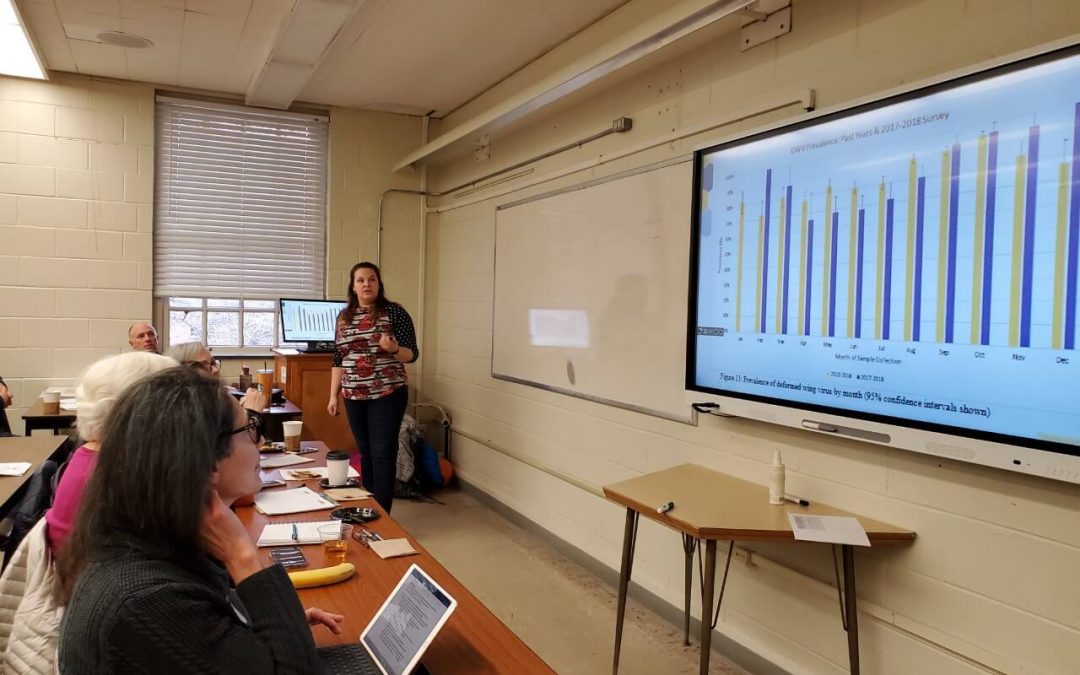
On Saturday, January 18, 2020, Wesley College hosted the Delaware Beekeeping Association’s beekeeping workshop for beginning and intermediate beekeepers for the fifth time. With over 150 eager enthusiasts of all ages in attendance, it’s safe to say this event was quite the buzz. Beekeeping is something that is not unfamiliar to Wesley College. Biology professor, Dr. Kathleen “Kathy” Curran, Wesley business adjunct, Joseph Nicolai, and Wesley biology alumnus, Ken Outten, took part in the workshop as instructors excited to share their knowledge. Last year, Wesley took steps to become a Bee Certified Campus. Both beginner and intermediate classes gained insights into bee biology, prevalent bee diseases, and bee equipment operation. Intermediate beekeepers also learned how to breed queen bees, a particularly valuable skill in the face of massive decreases in bee populations as well as techniques to market honey products. Funding was happily provided in part by Project WiCCED*, a collaboration among Delaware colleges that seeks to address water security challenges in Delaware and around the world. These threats negatively affect ecosystem function and critical economic drivers. Bees, too, need a clean source of drinking water to pollinate the food we eat every day.
Written By: Katelynn “Katie” Fry, Wesley Environmental Science STEM Ambassador Senior
*Funded in part by the Delaware EPSCoR (Established Program to Stimulate Competitive Research) program funded by the National Science Foundation and the State of Delaware under grant number OIA-1757353.
Read on the Wesley website.
Jan 31, 2020 | WiCCED Archive
Consuelo McGowan was treading the dusty grounds of a rental mobile-home community in Ellendale, Delaware, known as “The Hole.” Trash and old furniture were strewn all around, though McGowan and other volunteers cleaned up a few months ago.
She climbed the concrete steps of an old gray home and knocked on the door. “Hello! I’m here to offer free water test kits,” she said cheerfully.
The people who live here are forced to drink bottled water. Their private wells are contaminated, and the water that comes from them is smelly and undrinkable — it has tested positive for high levels of nitrates and iron. For decades, Ellendale residents pushed to connect to a public water system — and by October 2021, they will, thanks to a successful 2018 referendum.
Read the full article by Zoë Read on WHYY.