Nov 28, 2022 | WiCCED Archive
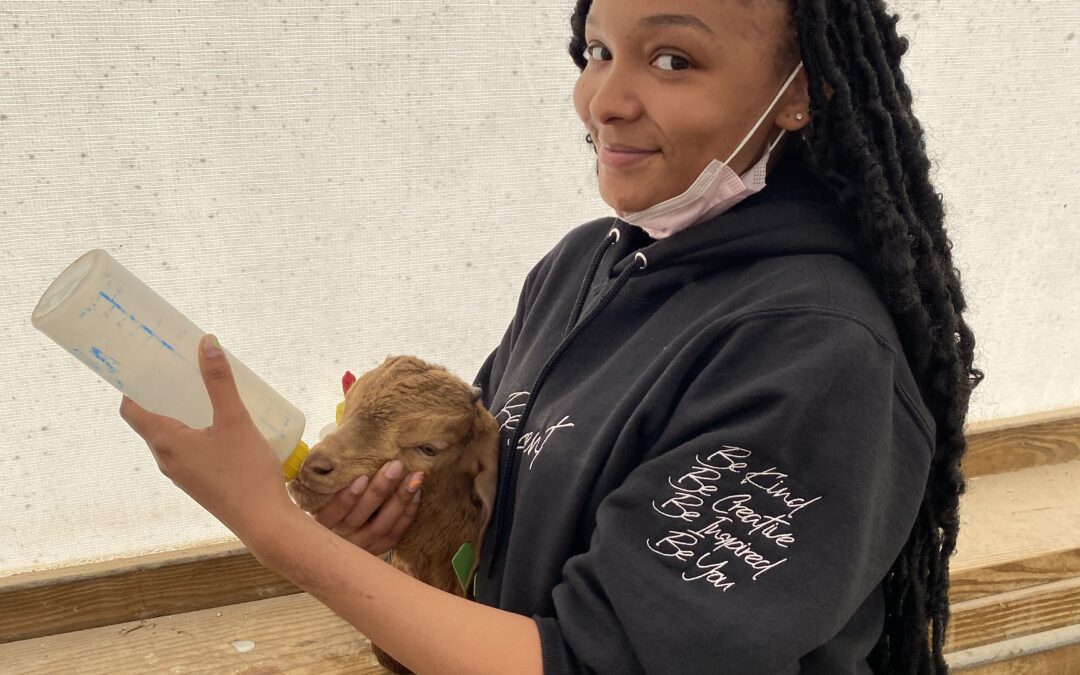
Ayiana James was a summer intern for Project WiCCED at UD in 2021. The research and professional development skills she learned in the internship helped James enroll as a master’s student in animal science at UD this fall, with a teaching assistantship that covers her tuition and provides a stipend for living expenses.
Project WiCCED is a multi-institution project in partnership with the National Science Foundation and the State of Delaware aimed at assessing major threats to Delaware’s water quality and developing viable solutions to meet those challenges. Project WiCCED summer interns participate in professional development activities to help get students ready for the next phase of their scientific career.
In summer 2021, James studied parasites in horses and the effectiveness of treating parasites with various concentrations of three different classes of dewormers. This work provided the basis for an ongoing investigation of how horse parasites become resistant to dewormer drugs. This research enabled Ayiana to develop skills needed as a graduate student, such as working on a research team, organizing and planning experiments, and presenting findings.
“The internship helped me prepare for graduate school because it allowed me to be part of a hands-on project,” said James. “This allowed me to fully grasp the steps that go into conducting a research project.”
James has not yet committed to a particular topic for her thesis research but is taking classes and gaining exposure to tools and procedures that will be important when she does. She is working in a UD lab focused on gut health in the production of chickens.
She has always been interested in science. Her aunt, Antonette Todd, a postdoctoral researcher in plant science at Delaware State University (DSU), consistently encourages her to push herself and helped James get into a summer research program there during high school.
James attended DSU as a USDA 1890 Agricultural Scholar and received the Corteva Developing Emerging Leaders & Talent in Ag (DELTA) Scholarship.
After working in a plant science lab during her first two years at DSU, James decided she’d like to try working with animals. Dr. Kwame Matthews, associate professor/small ruminant specialist at DSU, is trying to identify new means of parasite control that would be applicable for producers. With him and through the Project WiCCED internship, James has done fecal egg counts for parasites in goats, treated goats for parasites, and assisted in identifying anemia in goats and sheep. She has learned to do DNA and RNA isolation and to use the polymerase chain reaction technique to check for parasite infection.
She loves both the farm work and the lab work and is intrigued by the whole scientific process. “Scientists are so hands-on,” she said. “You see all the different steps and the processes that go into the experiment and the outcome.”
James is also gaining teaching skills. She is a teaching assistant for three classes—animal virology, animals and human culture, and one health—the idea that human, animal, plant, and environmental health are all interlinked.
James grew up in Philadelphia. Her aunt has been the biggest influence on so many of her school, career, and life decisions. “She said: ‘You can go after it and get it; it’s attainable if you put the work in,’” James said. Her aunt also taught her the importance of networking. “She really has gotten me out of my shell more, to just put myself out there more and take advantage of those opportunities.”
As for her future, James wants to do something hands-on with animals, but she’s keeping her options open. Life has been all about adjustment recently, as she’s graduated from DSU with a bachelor’s degree in animal science; gotten her driver’s license, a car, and an apartment in Newark; and started graduate school all within the past year.
James always keeps her “why” in mind—giving back. As a minority in agriculture, she knows that people are looking up to her and depending on her. “You can’t just give up because you’re tired today,” she said. “You can’t just give up because you feel like you don’t really know what you want in life right now. You can’t just give up on yourself.”
At DSU, James was involved with the Alliance for Minority Participation (AMP). She’ll speak there as an alum, to be a role model. She’s also been active with Minorities in Agriculture, Natural Resources, and Related Sciences (M.A.N.R.R.S.), and she plans to get involved with mental health community service organizations at UD soon.
By: Joy Drohan, EcoWrite | Photo Cedit: Elisha Buie
Nov 22, 2022 | WiCCED Archive
Jordan Watson, a master’s degree student in chemical oceanography at UD, recalls a time during his summer 2021 internship through Project WiCCED when, looking out from Lewes Beach, he saw dolphins crossing in front of the sunset and knew this was finally the right fit for him.
Project WiCCED is a multi-institution project in partnership with the National Science Foundation and the State of Delaware aimed at assessing major threats to Delaware’s water quality and developing viable solutions to meet those challenges.
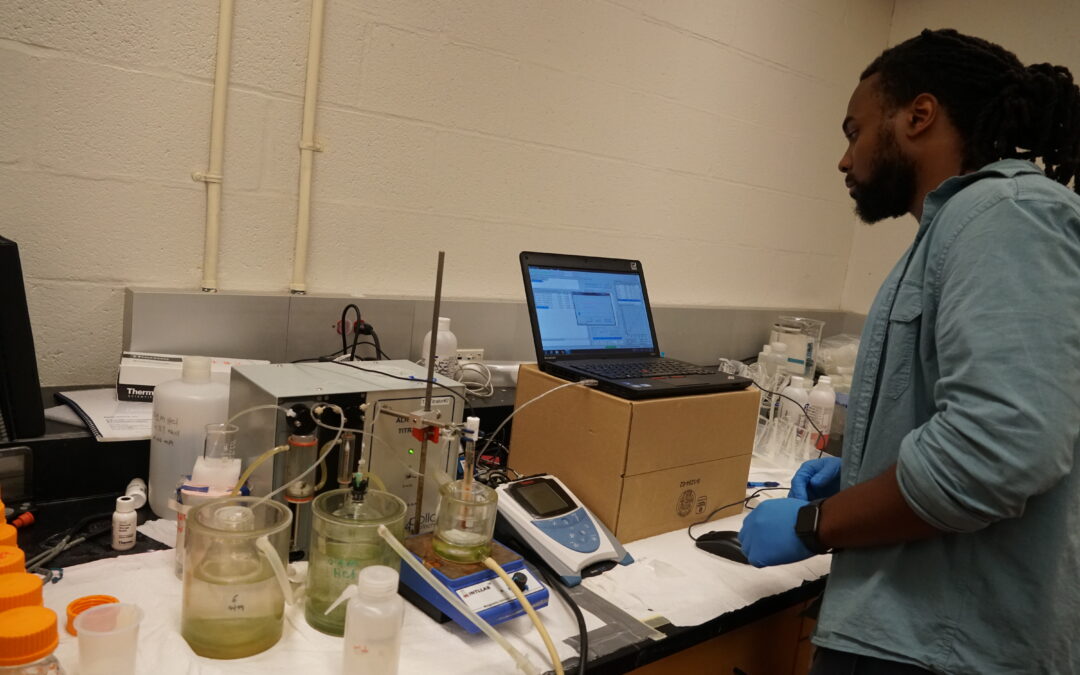
During the internship, Watson studied the biogeochemistry of tidal mixing in Delaware Bay and helped collect field samples and analyze them in the lab. His advisor was Wei-Jun Cai, Mary A. S. Lighthipe Chair of Earth, Ocean, and Environment.
Watson parlayed the internship into a research assistantship funded through Project WiCCED that covers his graduate school tuition and provides a stipend for living expenses, with Cai as his advisor.
Project WiCCED summer interns participate in professional development activities to help them get ready for the next phase of their career. The internship built Watson’s independence, self-motivation, and time management skills.
The road to this master’s program was winding. Watson graduated with a bachelor of arts in environmental studies, a minor in geology, and a certificate in GIS analysis from East Stroudsburg University in Pennsylvania in 2017. But before that, there was a lot of change. “I went through a lot of stages to get where I am,” he said.
Watson started college as a physics major—he wanted to be an aerospace engineer and work on airplanes—and also played football. It was difficult to balance them both. He switched majors to mammalogy, then biology, then environmental science.
Along the way, he had to choose between football and academics. “My entire life, I always thought I was a football player,” he said. “But I knew there was a higher ceiling with academics, so I stayed with that.”
“The fact that I’ve finally found my path and what I want to do, other than just football, is just very calming to me,” Watson said.
For his master’s research he’ll use advanced sensors to measure pH, temperature, salinity, and oxygen in the water near Delaware Inlet. These water quality measures are important for shell formation in crustaceans, and they’re changing in response to ocean acidification.
Watson hopes that his research will help contribute to global knowledge about climate change. Ocean acidification is driven by the rise in atmospheric carbon dioxide that is also causing climate change.
“If we don’t understand this,” he said, “and we don’t understand the ocean—the way that the ocean is acidifying––then indirectly the entire world will be affected.” Lower pH in the oceans will affect the availability of fish and seafood, for both people and other animals. About 10 percent of the world’s population relies on fishing for their livelihood.
Watson grew up the youngest of four children in Rockland County, New York, north of New York City.
His brother, Anderson, who is a senior scientist at pharmaceutical company Pfizer, has been an important role model in learning not to let setbacks stop him. “His determination is constant,” Jordan said. He helped teach Jordan time management. “He told me grad school is a marathon, not a sprint.”
His mom, a special education teacher, is also an important influence on him. She is his unfailing cheerleader, calms him down, and lifts him up.
In football, Watson recognized that he was overly hard on himself when he made a mistake. It affected his performance for the rest of the game. “I had to realize that it was myself that was holding me back,” he said. “I was always worried about what other people thought of me, what I was doing wrong.”
He learned to overcome this challenge through meditation, which he started after he quit football. “I felt for a long time like there was a vacant spot in my heart,” he said. Working out didn’t fill it, but “meditating just stopped all the static in my head and let me calm down.” Now he wakes up every day at 5 a.m. and meditates for 30–40 minutes. “It helps me find peace with myself,” he said.
It has also improved his ability to adjust to new challenges. “When I’m thrown into the fire, I can definitely adapt to any scenario I’m in,” Watson said. “So even though grad school is very stressful, I’m able to cope with it and just keep going.” He continued, “Many people don’t like the ocean because they can’t see the bottom and they fear the unknown. I don’t fear the unknown. I’m okay with learning something new. It just takes time. I have to just give myself time.”
After grad school, Watson is leaning toward a career in hydrogeology, hydrology, or water quality. “I want to be somewhere that there’s a high ceiling for me to keep going,” he said.
He played the cello as a boy, and has a great fondness for music—all genres. Music helped him learn to meditate and “definitely helped me become who I am today,” he said.
by: Joy Drohan – EcoWrite | Photo Credit: NOAA Ocean Acidification Program
Jul 21, 2022 | WiCCED Archive
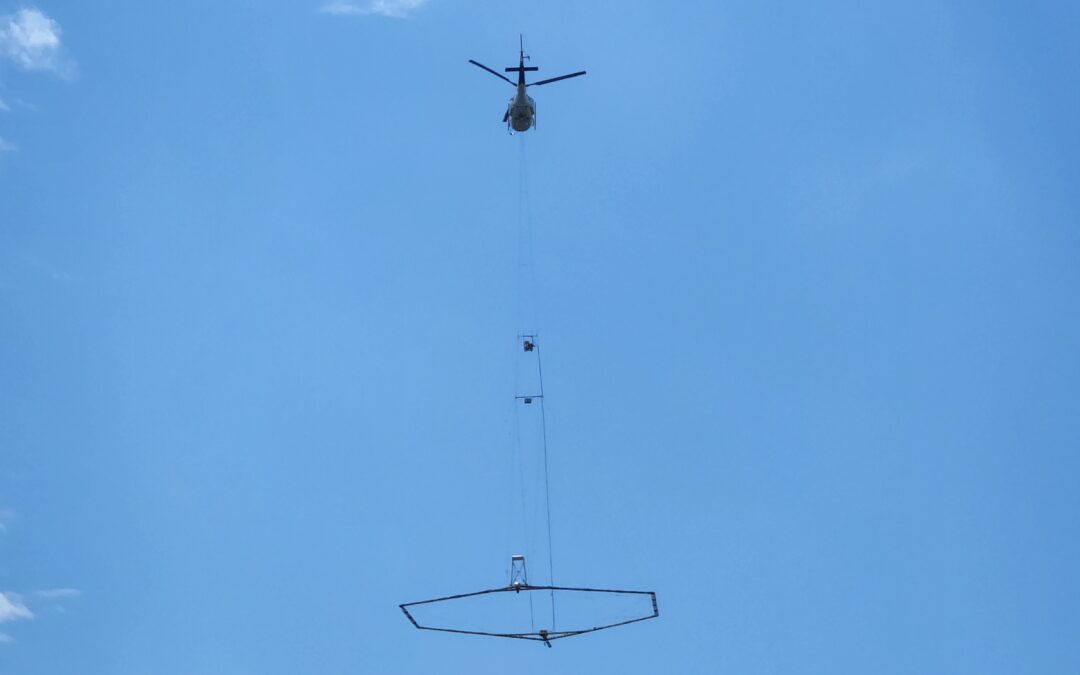
EPSCoR Project WiCCED sponsored the USGS to survey the Delaware Bay Area for data to improve understanding of groundwater salinity and below-ground geology. Rising sea level, increasing frequency and intensity of coastal storms and increasing demand for groundwater have amplified the risk of saltwater impacting water supplies in the region. To learn more, click link here for the USGS media alert and click link here to hear from our very own Dr. Holly Michael, Director of the Delaware Environmental Institute and PW Research Lead, talk about the project.